Adverb (Basic ㊦ 538)
An adverb indicating that the actual situation expectedly/anticipatively conforms to a standard based on past experience, comparison with other people, or common sense.
Equivalent: Still; also; after all; as expected; you know
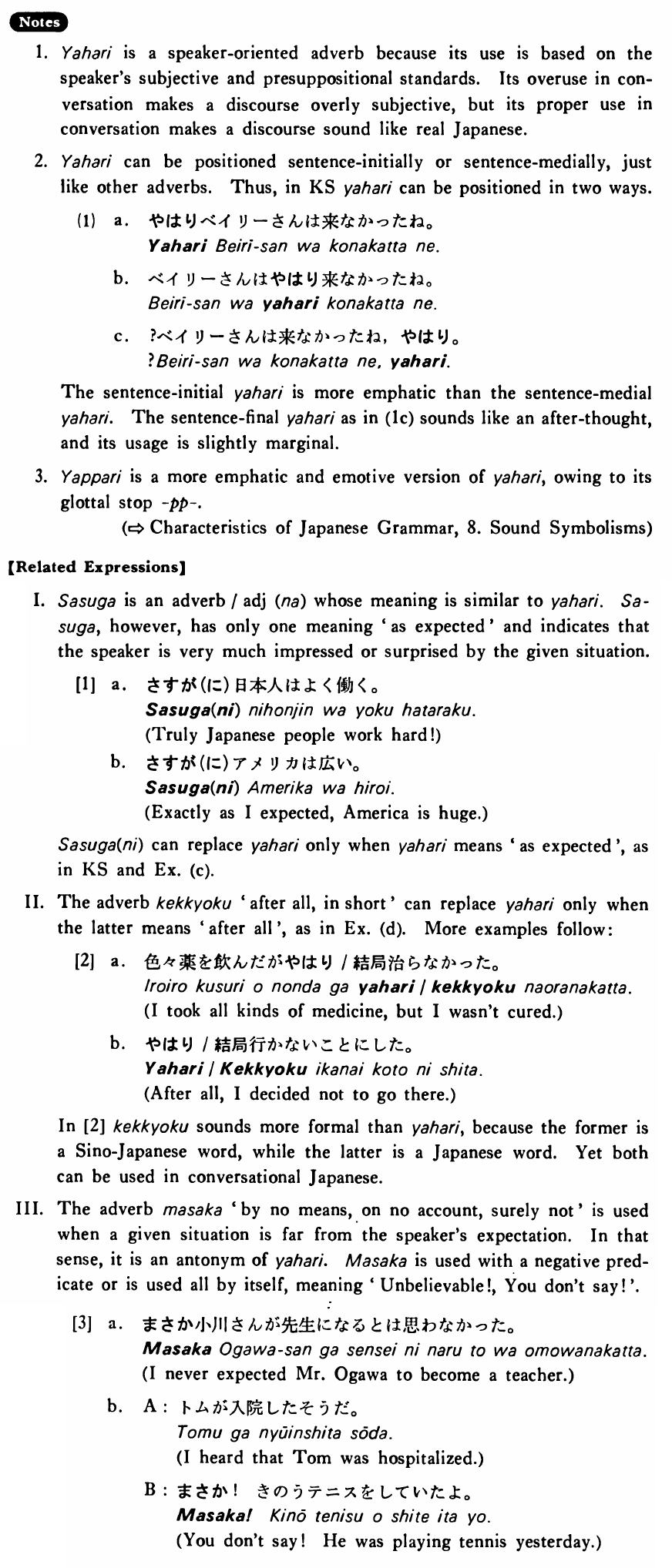
1. やはり is a speaker-oriented adverb because its use is based on the speaker's subjective and presuppositional standards. Its overuse in conversation makes a discourse overly subjective, but its proper use in conversation makes a discourse sound like real Japanese.
2. やはり can be positioned sentence-initially or sentence-medially, just like other adverbs. Thus, in Key Sentence やはり can be positioned in two ways.
The sentence-initial やはり is more emphatic than the sentence-medial やはり. The sentence-final やはり as in (1c) sounds like an after-thought, and its usage is slightly marginal.
3. やっぱり is a more emphatic and emotive version of やはり, owing to its glottal stop 'っぱ'.
【Related Expressions】
I. さすが is an adverb/adjective な whose meaning is similar to やはり. さすが, however, has only one meaning 'as expected' and indicates that the speaker is very much impressed or surprised by the given situation.
[1]
さすが(に) can replace やはり only when やはり means 'as expected', as in Key Sentence and Example (c).
II. The adverb 結局 'after all, in short' can replace やはり only when the latter means 'after all', as in Example (d). More examples follow:
[2]
In [2] 結局 sounds more formal than やはり, because the former is a Sino-Japanese word, while the latter is a Japanese word. Yet both can be used in conversational Japanese.
III. The adverb まさか 'by no means, on no account, surely not' is used when a given situation is far from the speaker's expectation. In that sense, it is an antonym of やはり. まさか is used with a negative predicate or is used all by itself, meaning 'Unbelievable!, You don't say!'.
[3]